

With the relocation of the main body of the Wagner Group to its new headquarters in Belarus, a steady uptick in the overall level of associated activity has been observed. That said, questions remain concerning what will become of those Wagner Group fighters who chose not to relocate to Belarus, and instead take up Putin’s offer of contracts with the Russian Ministry of Defence.
One very important observation made from the Wagner Group Telegram channel in recent days is an attempt by the Wagner Group and its followers to discredit a Telegram community created by the families of fighters missing or killed in action. The community is meant to share information that could lead to finding the whereabouts of Wagner Group fighters who have not made contact since they were deployed to fight in Ukraine.
Why is this important?
The existence of the Telegram group is significant in itself. Firstly, up until the closure of several Wagner Group communities on VK, the relatives of Wagner Group fighters would comment on posts requesting information regarding the status of their relatives. Additionally, many relatives – particularly wives – of deployed Wagner Group fighters would use the VK communities to raise concerns regarding the non-payment of salaries. But, the online communities also provided a lot of vital clues regarding how the Wagner Group operates and how they suppress the voices of family members.
Discrediting family members and removing their post comments
One of many user posts previously found on the Wagner Group recruitment page (before it was taken down) would be from the wives or mothers of fighters expressing concern for the whereabouts of their relatives. Typically, community administrators or Wagner Group followers would discredit the authenticity of such claims.

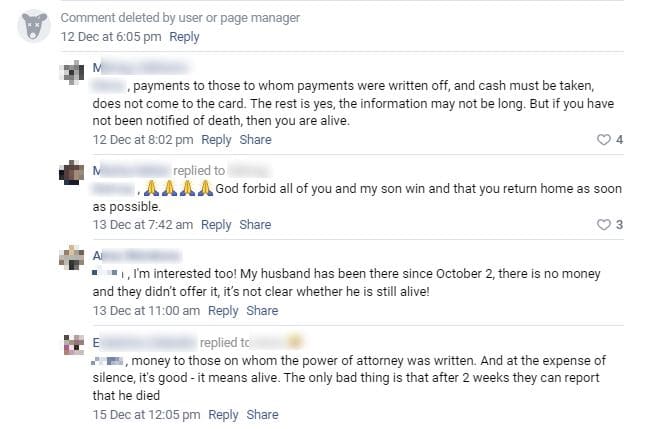
Soon after, such post comments would be removed – either by the user or by administrators. However, when considering the large number of comment removals (which – by default – does not remove replies to said comments), it can be judged that removals are instigated by the administrators rather than by the family members themselves.
Lengthy time periods until family members are notified of a relative’s death
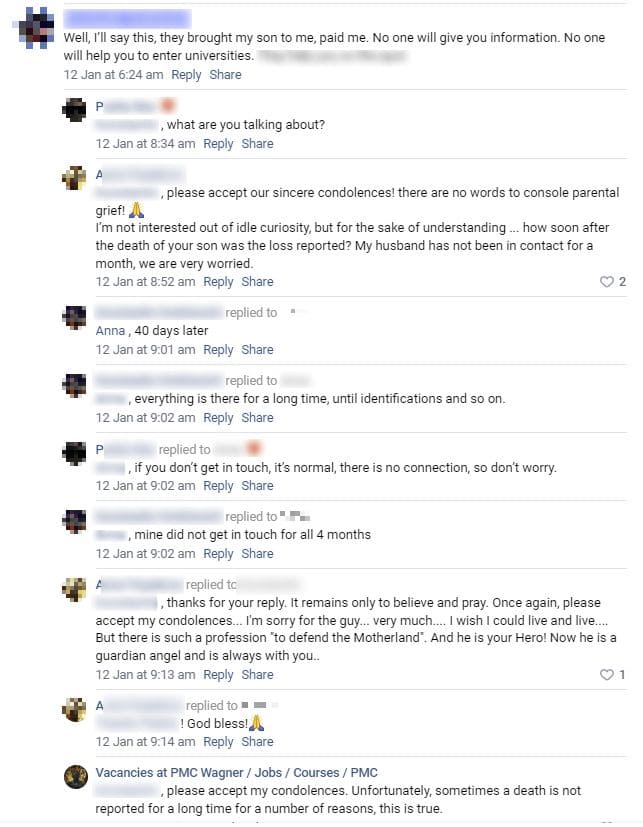
Several posts made by relatives indicate that during the period of intense fighting in areas such as Soledar and Bakhmut, families would often be notified of the death of their kin after a very long time. Indeed, a comment made by one relative indicated that he was informed of his son’s death 40 days after the event occurred. In a rare admission, one of the many administrators for the Wagner Group VK community acknowledged a lag between the death of a Wagner Group fighter and the notification of their next of kin.
Families turn to Telegram to voice their concerns
The primary reason why the families of Wagner Group fighters have turned to Telegram instead of VK is because of the Wagner Group rebellion on 23 June which resulted in Wagner Group communities being blocked from VK by order of the Russian General Prosecutor’s Office. Since then, the Wagner Group has maintained an active presence on Telegram via several channels and groups. The decision of the Russian General Prosecutor’s Office to block the Wagner Group communities on VK has not affected their ability to communicate with their followers in any way, shape, or form. This is especially the case considering that Telegram is more popular amongst Russians.
With all that in mind, the families turned their attention to Telegram and created their own community that at the time of writing has amassed nearly 12,500 members. A good portion of those members are probably OSINT sleuths and the like. Nonetheless, the considerably high membership number is significant.
In typical fashion, several of the Wagner Group channels warned their followers to report the group in question, suggesting that it had been created by “enemies” intended to obtain information regarding the identities of Wagner Group fighters.
Unanswered questions surrounding the fates of conscripted prisoners
One post from a concerned family member has drawn a lot of discussion regarding the fates of prisoners conscripted into the Wagner Group and sent to fight on the frontline. In the post, the family member saw his relative alive in a video showing conscripted prisoners returning home.
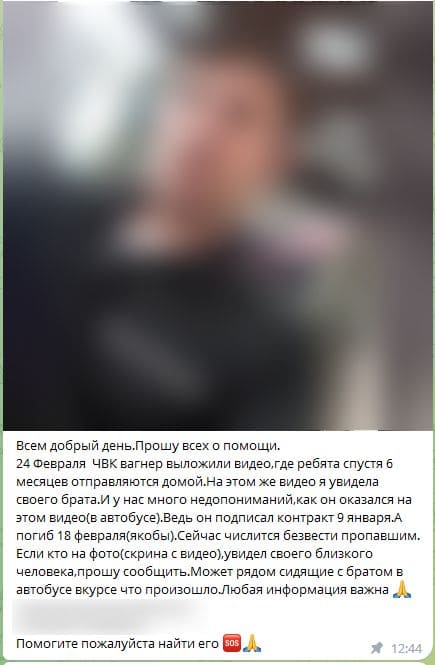
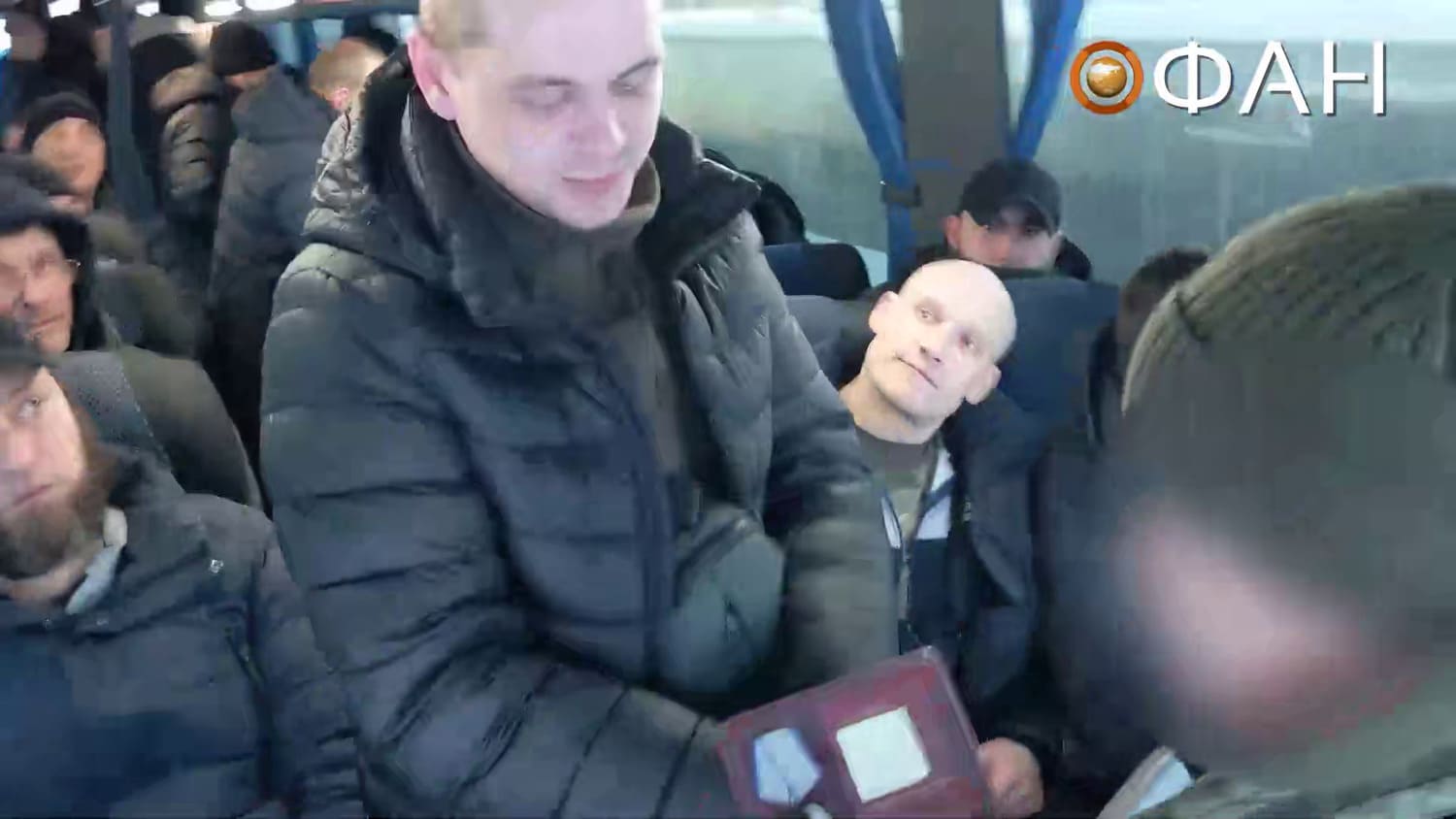
What is interesting about this post is that the relative claims that he saw his brother on the video published by the Wagner Group-associated RIA news agency on 25 February 2023 even though he signed a six-month contract with the Wagner Group on 09 January 2023. This fact does not align with the Wagner Group’s narrative as they claim that the video shows conscripted prisoners returning home after fulfilling their six-month contract and deployment to Ukraine. Of more interest, the relative also points out that his relative had supposedly died on 18 February 2023 – one week before the video was published online.
Although the video was likely recorded before 25 February 2023, it does raise questions as to the fate of the prisoner considering. So, let’s break the video down into segments:
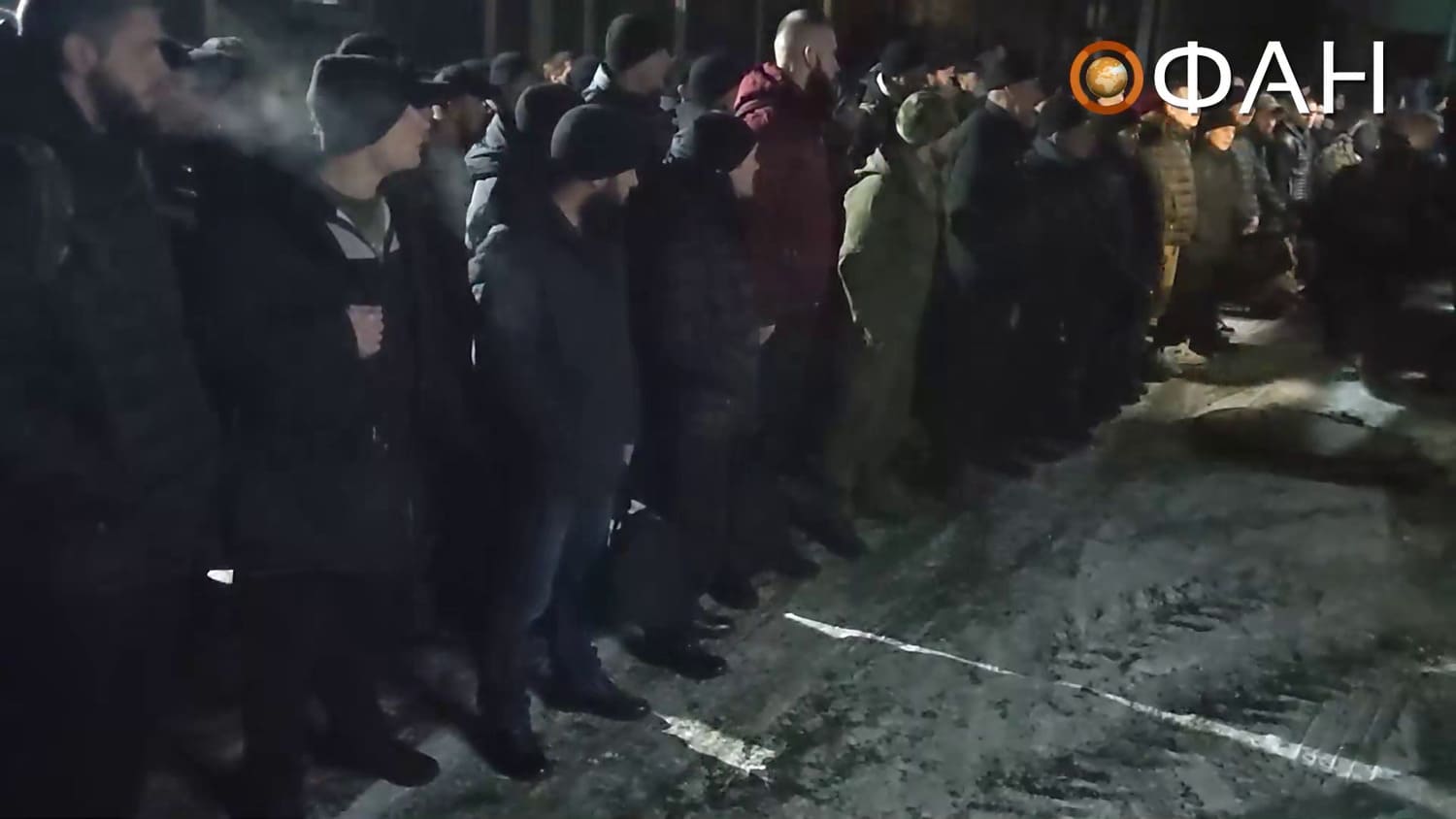

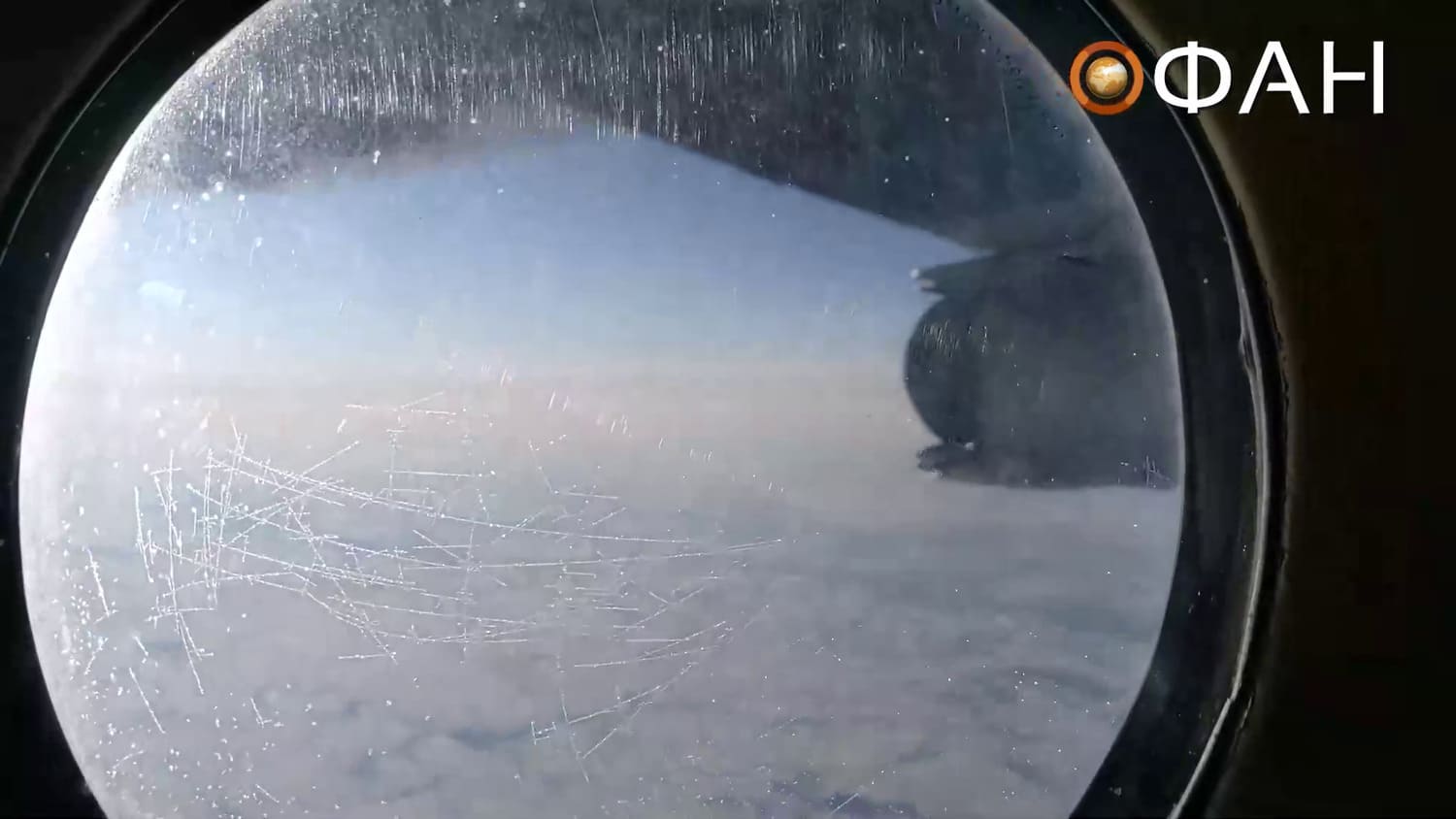
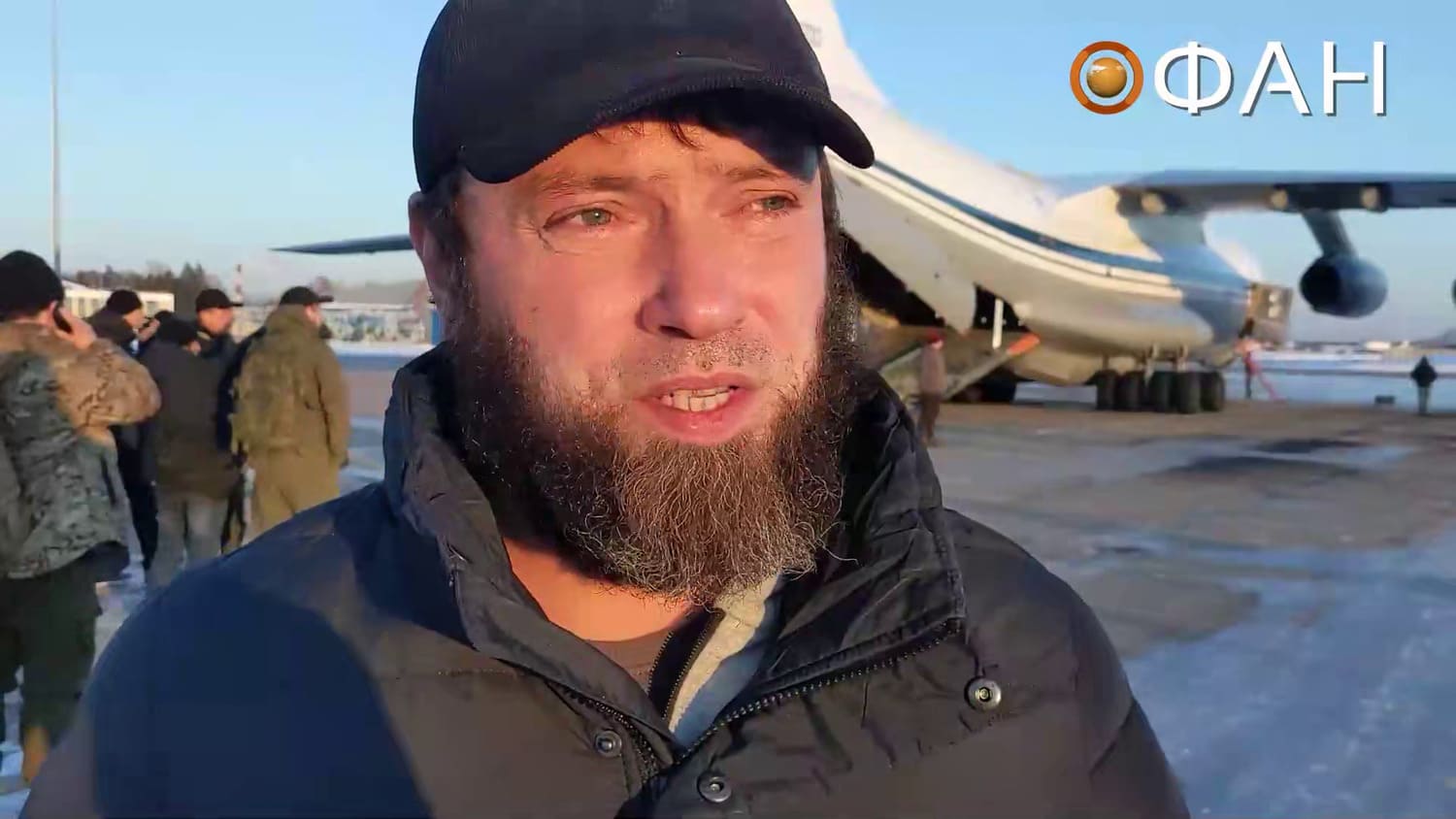
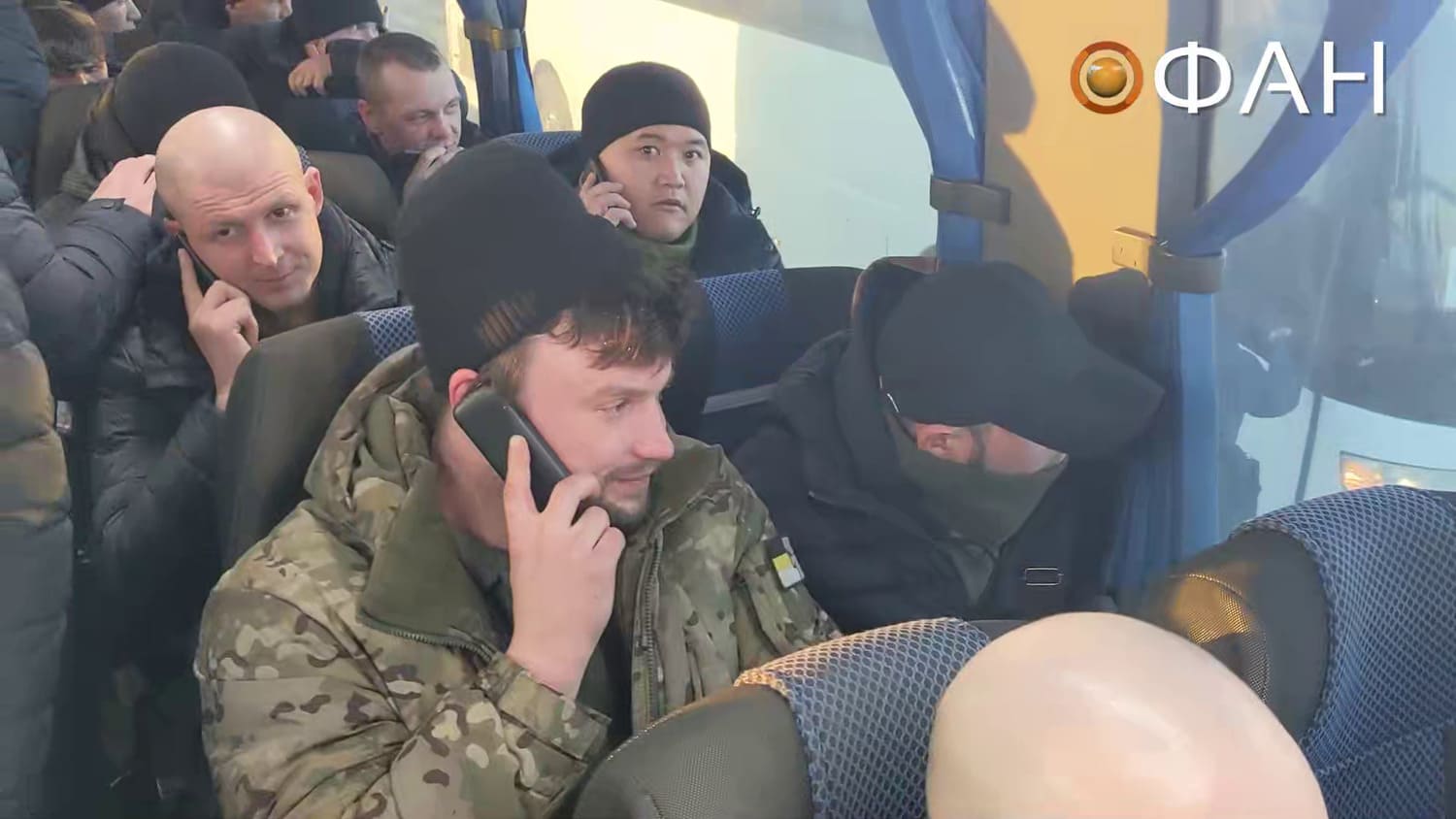
- 00:00 – 00:10s: The video – filmed in the dark – shows groups of men standing in formation.
- 00:10 – 00:20s: The men are called by a nominal roll where they proceed to board a bus.
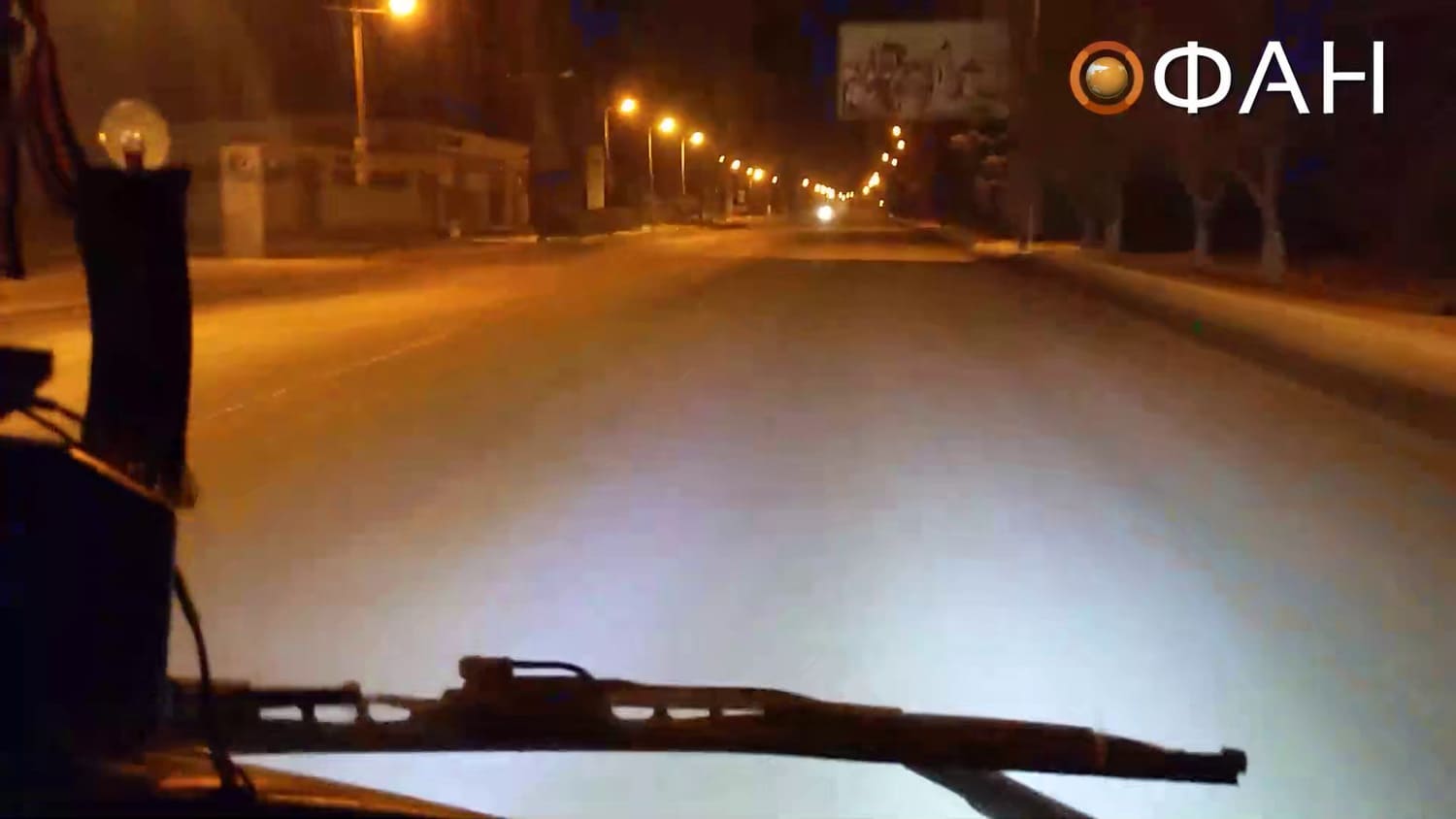
- 00:21 – 00:25s: The bus is observed travelling in an unidentified location in the middle of the night.
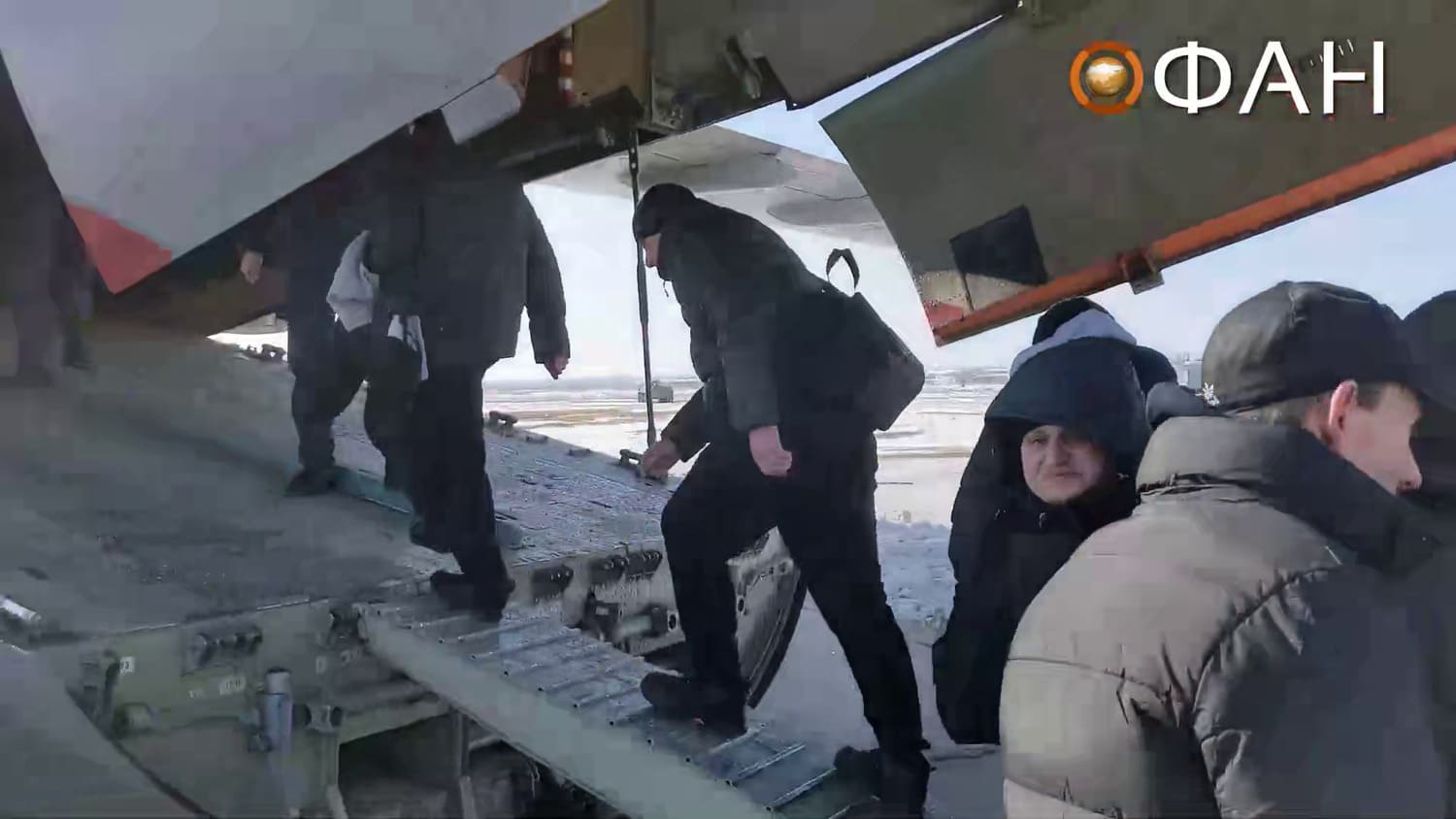
- 00:26 – 00:39s: The prisoners are observed disembarking from a bus and being loaded onto a transport aircraft at an unidentified airfield.
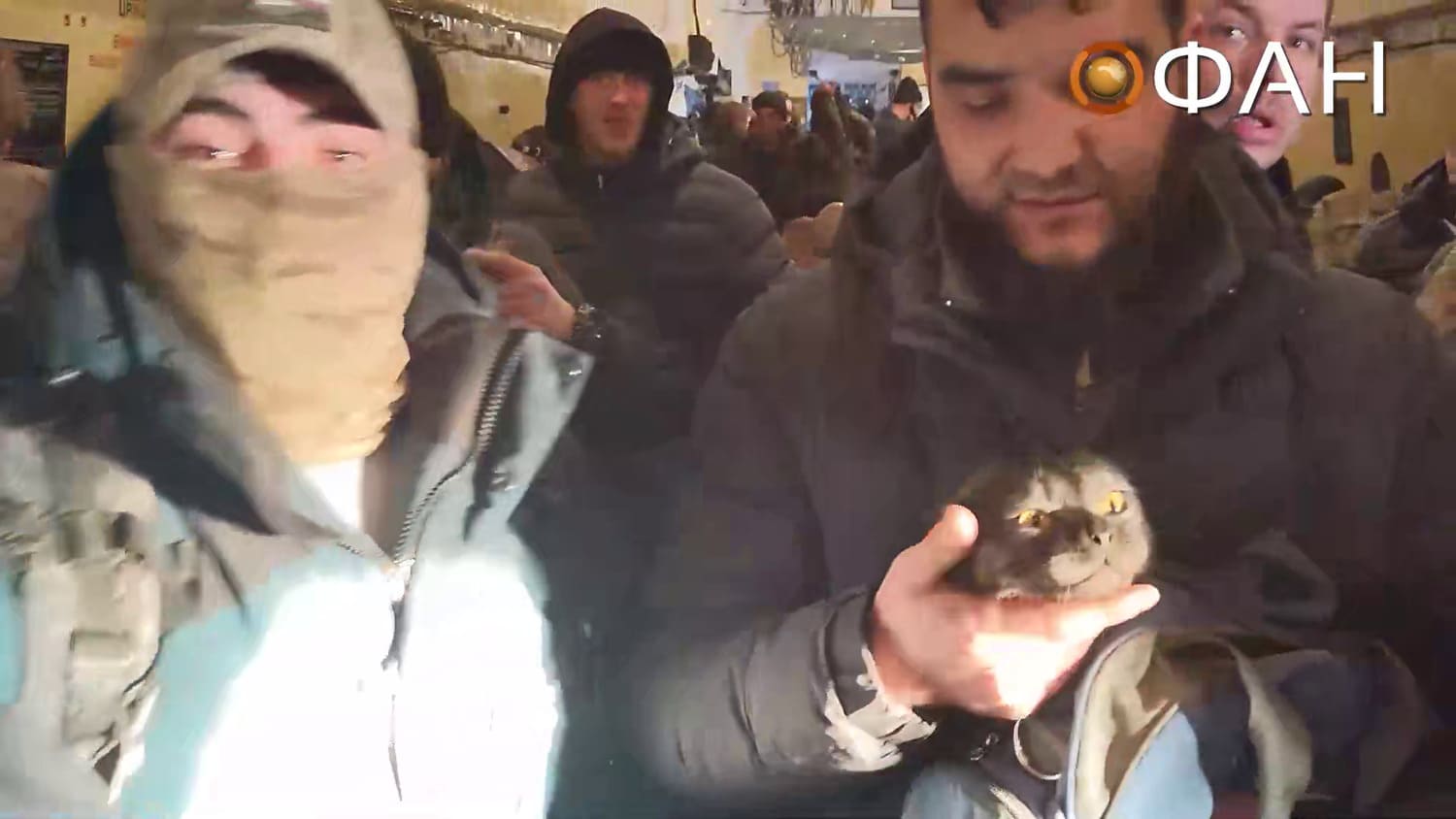
- 00:40 – 01:38s: The prisoners are interviewed on camera whilst onboard the transport aircraft with several shots taken to show that the aircraft is in mid-flight.
- 01:39 – 02:10s: The transport aircraft’s loading ramp is seen being lowered at an airfield. One prisoner is observed being interviewed on camera while the aircraft is seen being refuelled.
- 02:11 – 02:19s: Medals are being awarded to various prisoners while sitting inside a bus. The bus is also shown to be in motion.
- 02:20 – 02:29s: Prisoners are seen using mobile devices while the bus is stationary alongside another bus.
Aircraft positioning and timing
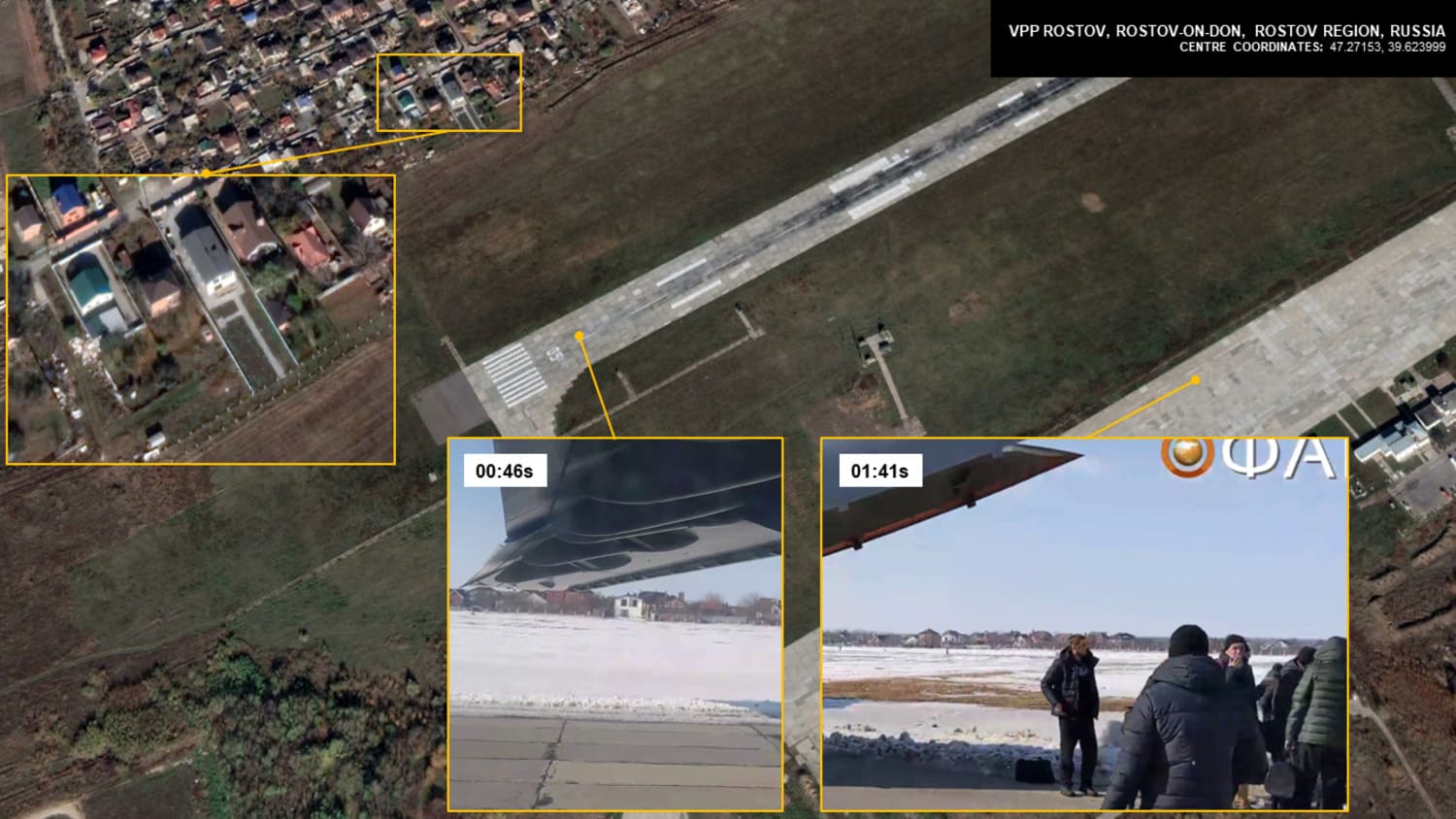
It should be pointed out that with the exception of the first few seconds, the video segments appear to have all been filmed at Rostov-on-Don air base.
The most striking observation from the video is that the activity shown and the timings from where they appear are inconsistent. For example, at 00:48s, the camera shows the transport aircraft on the runway of Rostov-on-Don air base with a close-up view of a set of distinguishable houses. Later at 01:41s, the camera shows the same houses from a distant observation point which is visually consistent with the aircraft being located at the apron of the airport. This is interesting as the video makes it appear that the prisoners were loaded onto the transport at 00:26s of the video, being interviewed mid-flight from 00:40s, and then loaded onto waiting coaches from 01:41s. However, the order of video segments could have been easily misplaced in order to create a longer video length (as is often the case!).
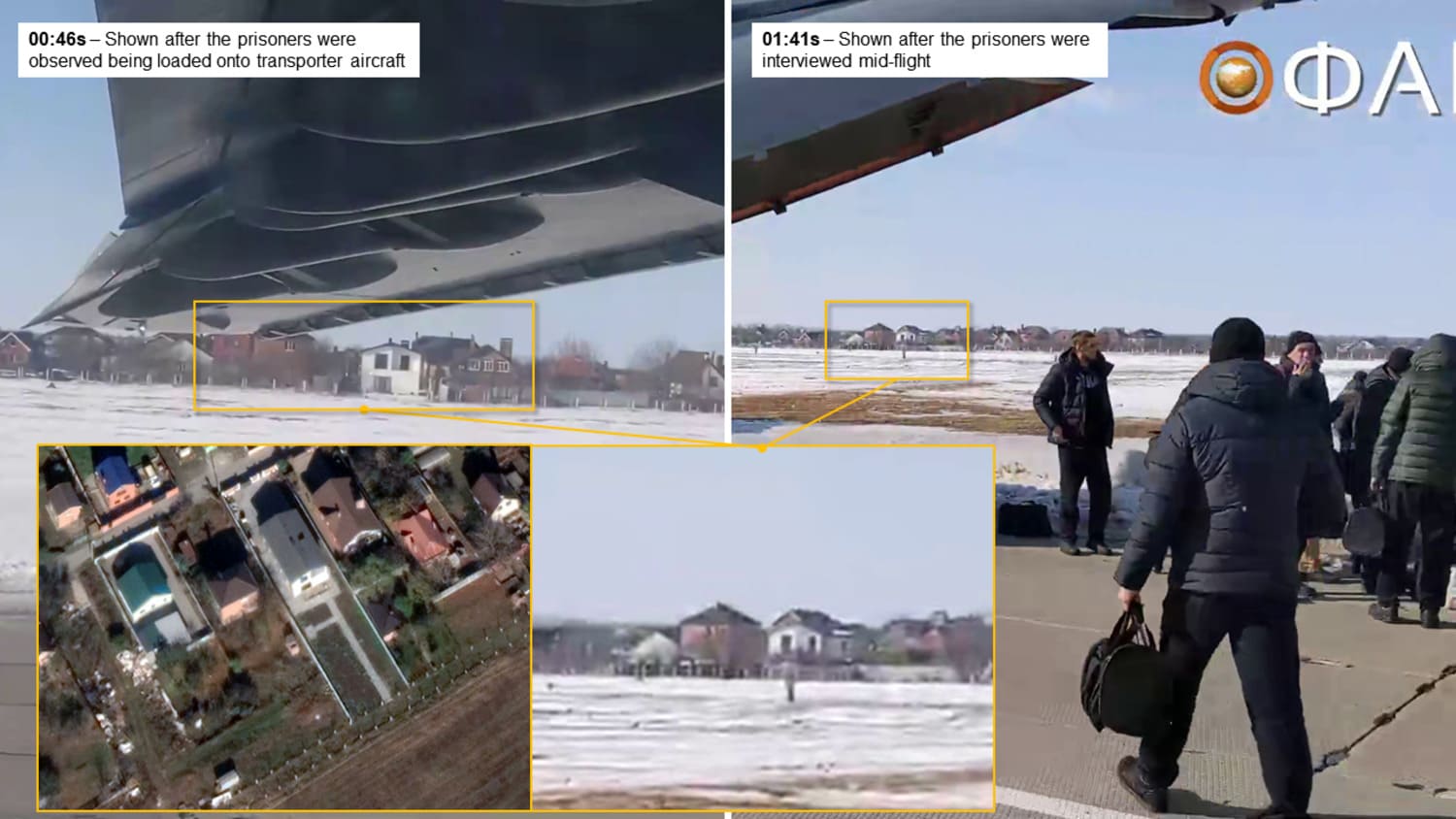
Direction of travel
One vital clue seen in the video could be seen at 00:22s. The shot shows the bus travelling along a single-carriageway road, passing a parking sign, an overhead billboard and some commercial buildings with distinguishable features. Additional clues within this video are the array of street lighting which shows lamp-posts with a nearly 90-degree straight angle.
Applying some geolocation analysis, the bus was found to be travelling south on Oboronna Street (also known as the M04 motorway), Luhansk at the precise coordinates latitude 39.356651, longitude 48.492267.
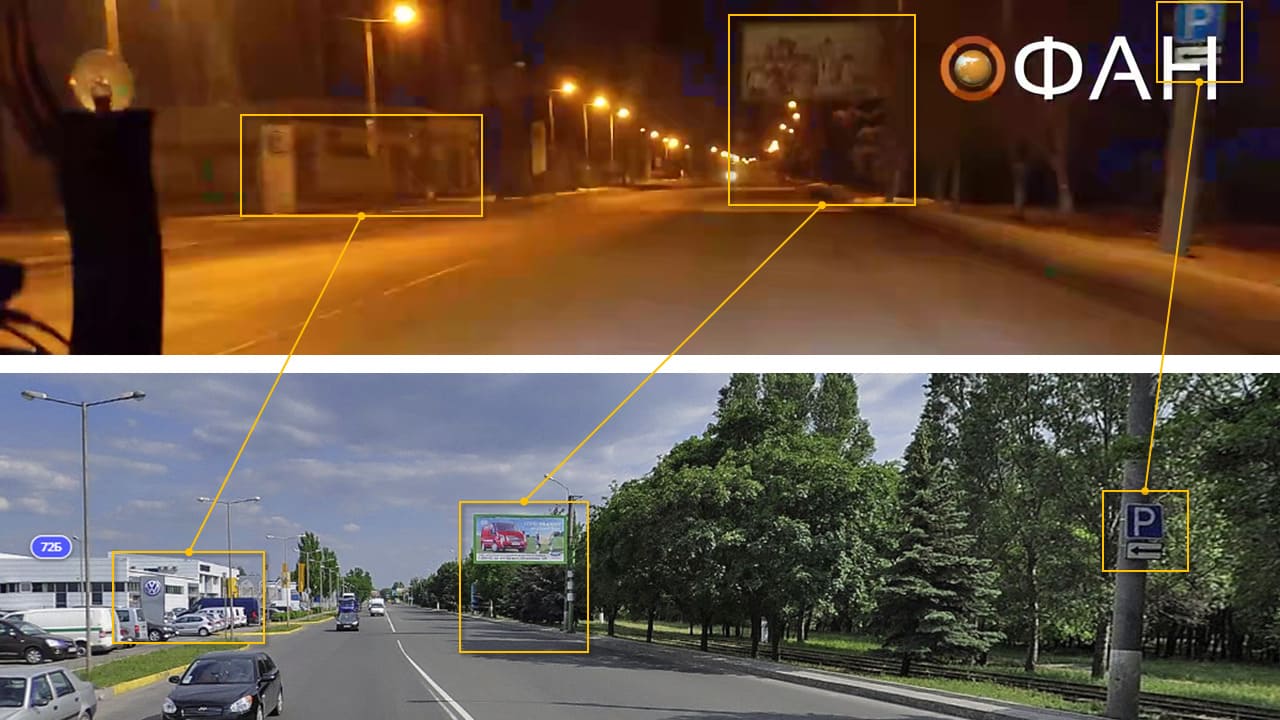
This finding now raises one important question: where was the coach going? What we know about the M04 motorway is that it is one of the main arterial routes linking the city of Luhansk to the international border. Likewise, it can also serve as part of the route linking Luhansk to Rostov-on-Don – taking approximately three hours when driving by car.
At this stage, there is no real reason to doubt the buses’ direction of travel. Additionally, we can see from images that a distinguishable feature on one of the buses is later seen in the video.
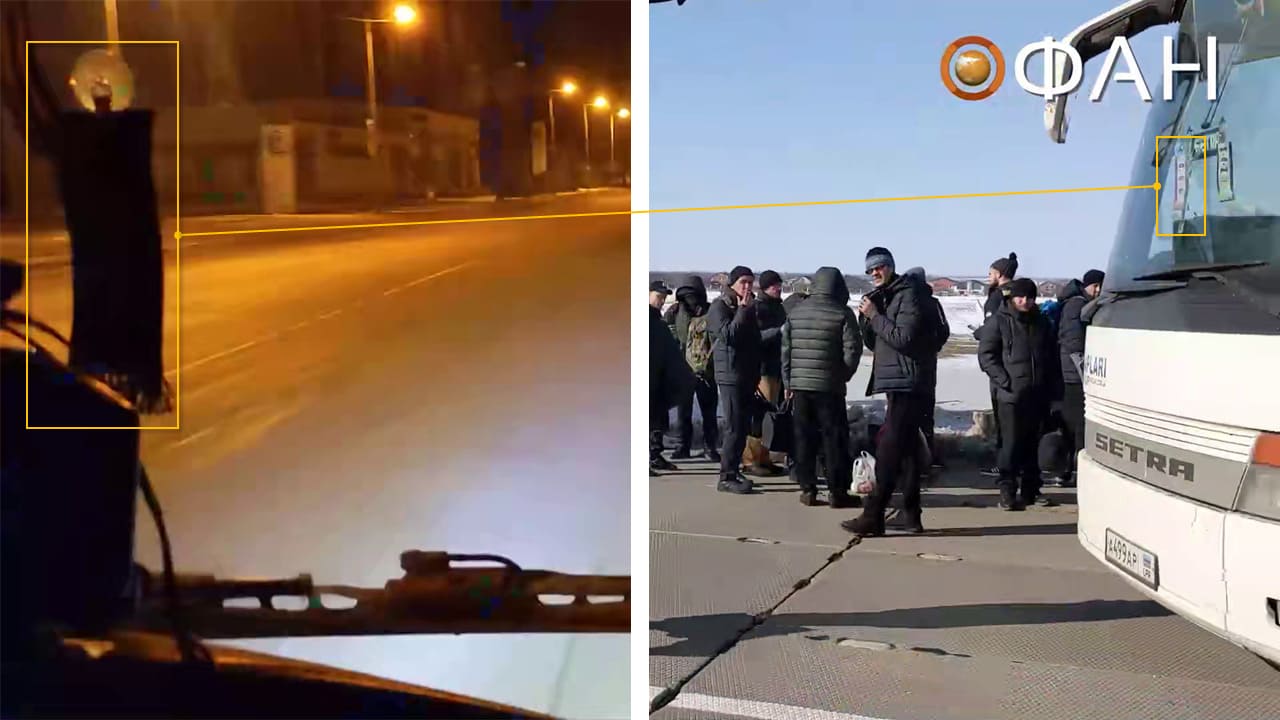
But, what is most striking is that the distinguishable feature is shown on the same bus at 01:42s into the video.
The aircraft’s final destination
Very little is known about the aircraft’s final destination. From the video frames, it can be deduced that the aircraft probably landed in the south of Russia, possibly Anapa. Which is also interesting considering that Anapa has served the Wagner Group as an air bridge between its former training facility in Molkino and Rostov-on-Don. What doesn’t make sense is why the Wagner Group would fly returning prison conscripts to the south of Russia rather than a more central location from where they could disperse to major cities. That all said, there are likely to be logistical factors which would explain the final destination of the aircraft.
Inconsistencies concerning the identities of prison conscripts
One major clue that would point to the video having been altered to deceive the families of prison conscripts is that the faces which appear at the start of the video do not appear elsewhere.
To analyse the video in this level of detail, Paliscope YOSE was used to compile the faces of prison conscripts and identify where in the video they appear.
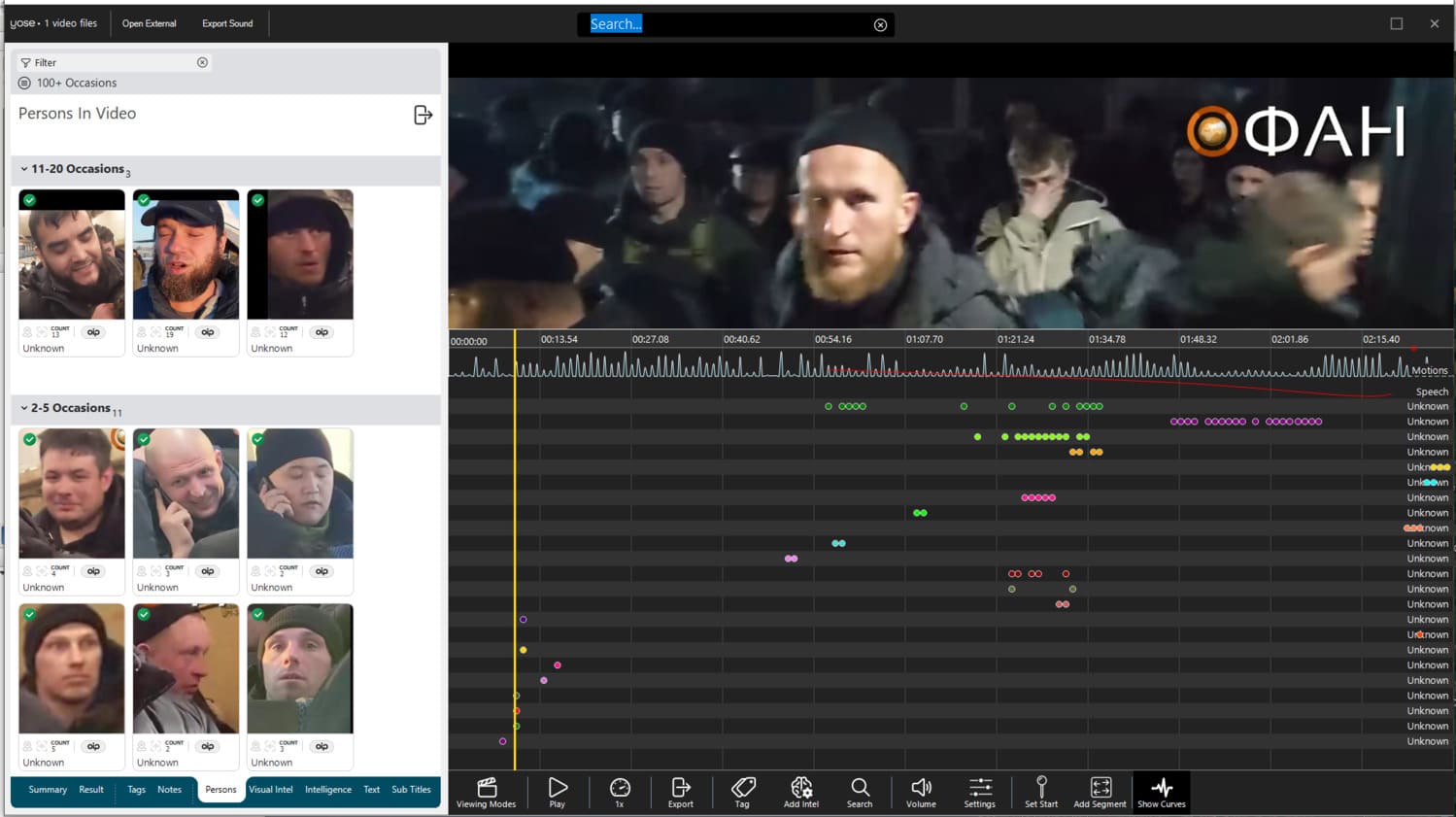
What the analysis undertaken by YOSE indicated was that from 00:00s until 00:20s as many as 10 faces were detected in the scenes involving the prison conscripts standing in formation and being called forward by a nominal roll. However, what YOSE also tells us is that those same faces do not appear during the remainder of the video. It could be argued that this is a pure coincidence. However, of the faces detected from 00:40s until the end, there was a better level of consistency concerning occurrences where the same face appeared in the video.
What does the video metadata tell us?
Interestingly, a lot of the file’s metadata was retained and subsequently analysed – revealing crucial details. Again, using Paliscope YOSE, we can see that the video was created using Adobe Photoshop on 23 February 2023.
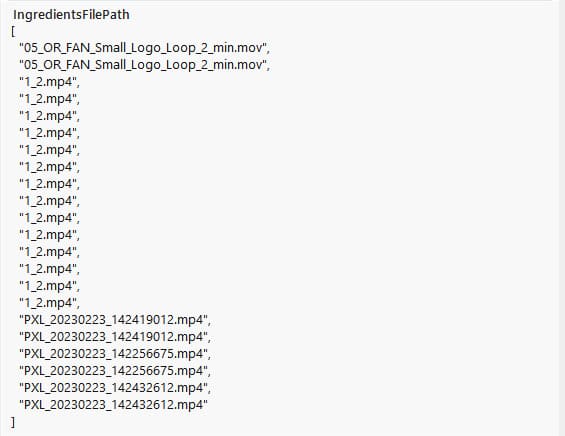
Going further, we can also see that the Pantry project file path points to a user named ‘Sergey’. Additionally, the user stored the Adobe Photoshop project file in a folder named ‘FAN_2021’. The IngredientsFilePath, which in this case details the separate files used to create the final video file shows several inconsistencies.
So, let’s break it down, the main video refers to a video file named ‘05_OR_FAN_Small_Logo_Loop_2_min.mov‘ on two occasions – this is most likely to be the RIA news agency logo which is located primarily on the top right corner of the video.

The main video also refers to a file named ‘1_2.mp4‘ on a handful of occasions, this is most likely to be a significantly cut-down video segment which shows the group of prison conscripts standing in front of two buses whilst their names are called out. Lastly, the main video refers to three different files named ‘PXL_20230223_142419012.mp4‘, ‘PXL_20230223_142256675.mp4‘, and ‘PXL_20230223_142432612.mp4‘. The latter three files likely refer to the segment of the main video which shows the prison conscripts at Rostov-on-Don air base and onboard the transport aircraft.
What is interesting about the latter three files is that they were highly likely created using Google Camera because from version 7.5 and up, each file generated using the device begins with a filename prefix of ‘PXL‘. What this tells us is that the segments at the start of the video showing the prison conscripts in formation were filmed on a different device, possibly at a different date and time to the rest of the video segments.
What happened to the prison conscripts?
This is certainly the burning question for the intelligence community and the relatives of fighters confused by videos posted by the Wagner Group during the early months of 2023. What can be confirmed by various news reports is the some prison conscripts have indeed returned home – some of whom have since been arrested and charged for crimes. For their part, the Wagner Group has maintained that some prison conscripts have signed volunteer contracts. Presumably those who have volunteered were returned to the frontline in Ukraine. Some uncorroborated reports, meanwhile, indicate that some fighters were left behind in Bakhmut and have been unaccounted for since the rebellion on 23 June 2023.
What is important to note is that prisoners conscripted into the Wagner Group were promised that they would be pardoned in exchange for fighting in Ukraine for six months. Pardons of this nature can only be granted by Putin himself, and there is no material evidence that he has put pen to paper in this regard. Indeed, reports further indicate that pardons are classified as Russian state secrets.
Evgeny Prigozhin claimed in March 2023 that more than 5,000 prisoners were released on pardon after completing their contracts, adding that 0.31% of those pardoned had gone on to commit crimes. However, if it is the case that Putin has granted pardons to Wagner Group prison conscripts, it would be considered unlikely that all conscripts that returned from the frontline alive would have been pardoned. It is plausible that the Kremlin could have established quotas concerning the number of pardons to be issued.
The case concerning the individual who has not made contact with his family since the video of his alleged release does raise questions as to what has actually taken place. It is possible that the video in question was meant to intentionally deceive viewers by showing conscripts fulfilling their contractual obligation. However, the relative claims that the individual in question signed a contract with the Wagner Group on 09 January 2023 and was then seen being released on a video created on 23 February 2023. This is impossible based on the fact that all Wagner Group contracts are for a period of six months – except in the case of deployments to Africa which demand a 12 month contract.
How the video in question was constructed also brings together some clues as to what may have actually occurred. The first segments of the video shows prison conscripts whose do not appear elsewhere in the video. Those same segments were also created with a different device and were allocated a filename that differs significantly to other segments in the video. These details could potentially point to the video potentially showing prison conscripts being taken to Ukraine to begin their six-month contract instead of the opposite.
That aside, the analysis of the video, coupled with the extremely large number of posts made by the relatives of conscripted prisoners, does raise more questions rather than answers. Most concerning is the fact that the Wagner Group has taken active steps to supress the voices of those relatives. These questions come at a time when the Wagner Group is also taking active steps to fully establish itself in Belarus and maintain an image that would make their followers believe that they are the so-called ‘heroes’ of Russia.


